
Snow day calculator
An estimate from the NWS forecast, not an official closure. Always confirm with your school or district. How schools decide snow days
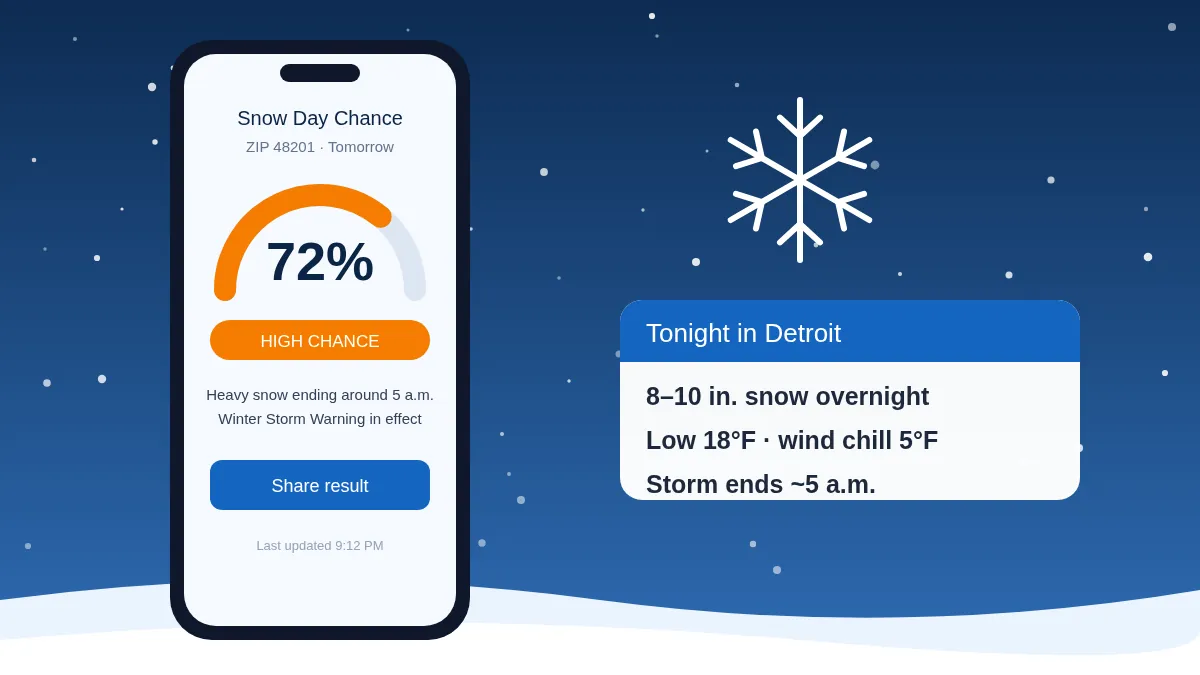
Quick answer: Type your ZIP code into the snow day calculator above and pick your school type. It reads the overnight and early-morning forecast for your area, weighs snow, ice, cold and timing, and gives you a percent chance that school will be closed or delayed tomorrow. Anything above 75% means a closure is likely, but only your school district can make the final call.
Every winter the same question hits group chats around 9 p.m.: “Are we getting a snow day?” This page gives you a fast number, then explains what is behind it, why two towns with the same snow can get different answers, and where to check the real announcement in the morning.
How to use the snow day calculator
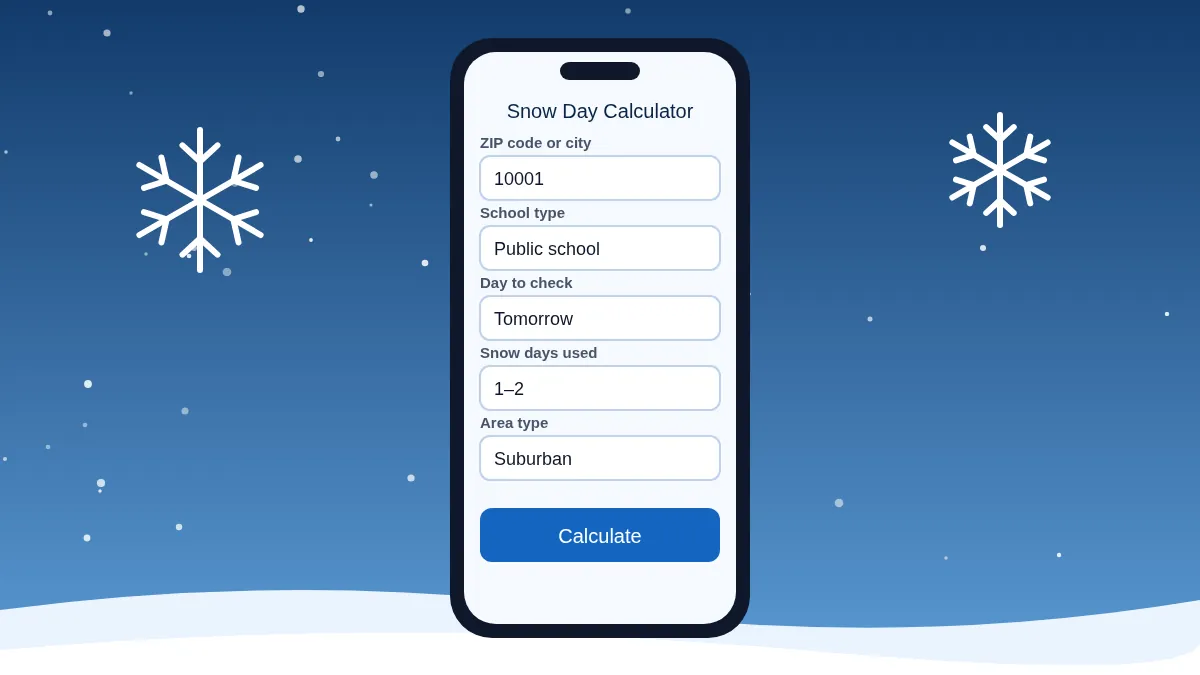
The tool takes under a minute. You only need your ZIP code, though the extra fields make the number fit your school better.
- Enter your ZIP code or city. The forecast is pulled for that exact spot, not the nearest big city. A ZIP in the hills outside Denver will read very differently from one downtown.
- Choose your school type. Public districts run buses on long routes, so they close more readily than many private schools or colleges.
- Pick the day. Check tomorrow the evening before, or pick Monday on a Sunday afternoon.
- Add how many snow days your district has used. Districts with several closures already on the books tend to hold out longer.
- Choose your area type. Rural and hilly districts close earlier because back roads get plowed last.
- Press “Calculate”. You get a percentage, a short reason and the time the forecast was last refreshed.
If you know your local forecast well, switch on manual mode. You can enter your own snowfall total, ice, temperature and storm timing to test “what if” cases, like what happens if the snow starts four hours later than expected.
How the snow day predictor works
A snow day predictor does not know what your superintendent will decide. What it can do is look at the same things superintendents look at and turn them into odds.
Our model starts with the hourly forecast for your ZIP code for the hours that matter: roughly midnight to the end of the morning bus run. It checks expected snowfall, freezing rain, temperature, wind chill and wind. It then checks whether the National Weather Service has posted a watch, advisory or warning for your county.
After that it adjusts for things that are not weather at all. These include your school type, how rural your area is, how many snow days your district has already used, and how often places with similar winters close. A town that sees 80 inches a season treats 4 inches as a normal Tuesday. A town that sees 5 inches a season may shut down for the same storm.
The data behind the prediction
| Input | Where it comes from | Why it matters |
|---|---|---|
| Hourly snowfall and ice | National Weather Service forecast grid | Snow on the roads at 6 a.m. is the main closure trigger |
| NWS watches, warnings, advisories | weather.gov alerts for your county | A Winter Storm Warning sharply raises closure odds |
| Overnight low and wind chill | NWS hourly forecast | Kids waiting at bus stops in dangerous cold |
| Storm start and end time | Hourly forecast | Overnight storms close schools; afternoon storms often don’t |
| Local snow climate | Long-term averages for your area | Snow-used-to areas need more snow to close |
| School type and area type | Your answers | Bus routes and rural roads change the decision |
| Snow days already used | Your answer | Districts low on spare days hold off longer |
What your snow day chance means
A percentage is only useful if you know how to read it. Here is how we suggest you treat the number the snow day calculator shows.
| Snow day chance | What it usually means | What to do tonight |
|---|---|---|
| 0–24% | Little or no snow, or normal winter weather for your area | Plan a normal school day |
| 25–49% | Some snow or ice, but roads should be manageable | Normal plan; glance at alerts in the morning |
| 50–74% | A real storm with a decent shot at a delay or closure | Pack the bag anyway, but line up childcare just in case |
| 75–89% | Heavy snow, ice or extreme cold timed for the morning | Expect a delay or a closure; check alerts at 5–6 a.m. |
| 90–99% | Major storm or warning already in effect | A closure is very likely; watch for the district’s call tonight |
Keep in mind that a high number does not guarantee a snow day. It means the conditions that usually close schools are lined up. In districts with a remote-learning rule, such as New York City, a “closure” can still mean logging in from home. Our NYC DOE snow day guide covers how that works.
Factors that raise or lower your snow day probability
Snowfall gets all the attention, but the snow day probability depends on a mix of things. These are the ones that move the number most.
Snowfall amount and rate
Total snow matters, but so does how fast it falls. An inch an hour during the morning commute is far worse than six inches spread over a full day. Plows simply can’t keep up with heavy rates.
Ice and freezing rain
A thin glaze of ice can close schools faster than a foot of snow. Buses can’t stop safely on ice, and sidewalks become dangerous for walkers. Even a tenth of an inch of freezing rain can make roads slick and dangerous, which is why the calculator gives ice extra weight.
Extreme cold and wind chill
Some closures happen with no snow at all. When temperatures or wind chills fall to dangerous levels, children waiting at bus stops face frostbite risk. Since October 1, 2024, the National Weather Service issues an Extreme Cold Warning or a Cold Weather Advisory for these days; they replaced the old Wind Chill Warning and Wind Chill Advisory.
Storm timing
Timing is often the deciding factor. Districts make most calls between about 4:30 and 6 a.m., before the first buses leave. If the worst falls between 2 a.m. and 8 a.m., odds go up sharply.
Your region and your district
A Buffalo district and an Atlanta district will not react to the same storm the same way. Snow-belt areas have big plow fleets and drivers used to winter roads. Southern districts may close for an inch or two because they have few plows and little salt.
Snow days already used
Most states require a minimum number of school days or hours each year. Michigan, for example, forgives six days lost to conditions like severe storms before districts start needing extra approval or make-up days. You can read the details in our Michigan snow day guide.
Other factors
- Power outages at schools, or no heat in buildings
- Unplowed parking lots and sidewalks around campus
- Bus driver shortages on bad-weather mornings
- Neighboring districts closing, which can push a superintendent the same way
- Exam days or testing windows, which can make a district try harder to stay open
How much snow does it take to close schools?
There is no single number. The table below gives rough ranges based on how districts in different climates tend to react. Treat it as a guide, not a rule.
| Region | Snow that often leads to a delay | Snow that often leads to a closure |
|---|---|---|
| Deep South (GA, TX, AL, SC) | A dusting to 1 inch, or any ice | 1–2 inches, or any freezing rain |
| Mid-Atlantic (VA, MD, DC, NC) | 1–3 inches | 3–6 inches |
| Northeast cities (NYC, Boston, Philadelphia) | 3–6 inches | 6+ inches, or a blizzard |
| Midwest (OH, IL, IN, MI) | 3–5 inches | 6–8+ inches, or dangerous cold |
| Snow belt and northern states (Buffalo, MN, UP of Michigan) | 6+ inches | 10–12+ inches, or extreme cold |
| Colorado Front Range (Denver) | 3–6 inches | 6–10+ inches, depending on timing |
Notice that ice and cold show up in almost every row. These ranges are general patterns we see across districts each winter, not official thresholds. No district publishes a fixed inch count, so the snow day calculator works from conditions instead of a single cut-off.
Snow day chances for tomorrow: timing matters most
Most people check their snow day chances for tomorrow the night before, and that is the right time to check twice. Forecasts for overnight storms often shift between the evening and the early hours.
Here is a simple routine that works:
- Around 7–9 p.m.: run the calculator and read the reason line. Note whether the NWS has a warning out.
- Before bed: check again. If the storm has sped up or slowed down, the odds can jump or drop 20 points.
- At 5–6 a.m.: check your district’s alert, text or website. Many districts aim to decide by about 5 a.m.
Some districts announce the evening before when a big storm is certain. New York City, for example, announced its February 23, 2026 blizzard closure on the afternoon before. If you want a step-by-step look at reading tonight’s forecast, our page on snow day tomorrow walks through it. For a same-morning check, use our snow day today guide.
Checking for Monday or after a break
The calculator lets you pick a weekday. A Sunday storm gives crews the whole day to plow, so Monday odds can be lower than the snowfall suggests. Snow arriving late Sunday night does the opposite.
How accurate is a snow day calculator?
Honest answer: a snow day calculator is only as good as the forecast it reads, and it cannot read your superintendent’s mind. It works best as an early signal, not a promise.
Where it does well:
- Big, well-forecast storms. When a Winter Storm Warning is up and the snow is timed for the morning, high odds are usually right.
- Clear “no” nights. Light snow ending by midnight rarely closes schools.
Where it struggles:
- Borderline storms with 2–4 inches near the rain-snow line
- Ice events, which are hard to forecast to the tenth of an inch
- Local choices like a district that switches to remote learning instead of closing
- Late forecast changes after you last checked
That’s why our tool shows a “last updated” time and a short reason. If the reason says “snow ending around 3 a.m.,” you know crews may have time to clear roads. Treat any result in the 40–60% range as a coin flip and check again before bed.
Snow day, delay, early dismissal or remote day?
A storm doesn’t always mean a full day off. Districts have several options, and the calculator’s percentage covers any of them that disrupt a normal start.
| Option | What happens | When districts use it |
|---|---|---|
| Snow day (closure) | No school; buses and activities canceled | Heavy snow, ice or extreme cold during the morning |
| Delayed start (often 2 hours) | Buses and start time pushed back | Snow ending early morning; roads need a few more hours |
| Early dismissal | School ends early | Storm arriving during the school day |
| Remote learning day | Buildings closed; classes online | Districts with remote rules, such as NYC Public Schools |
| Cold day | Closure for dangerous cold, no snow | Extreme Cold Warning in effect at bus time |
In Denver Public Schools, for example, a weather delay means morning buses run two hours later and morning ECE (early childhood) classes are canceled. Our Denver Public Schools snow day page has the full rules.
Snow day calculator app and alerts
Many people search for a snow day calculator app. You don’t need to download anything to use ours: it runs in your phone’s browser. Add it to your home screen and it opens like an app.
On iPhone, tap the Share button in Safari, then “Add to Home Screen.” On Android, tap the three-dot menu in Chrome, then “Add to Home screen.” Next time it opens straight to the calculator with your last ZIP code saved.
For real closure alerts, sign up with your school district. Most districts send texts, emails or robocalls through their own system. Denver Public Schools, for example, sends alerts based on contact preferences set in the Parent Portal. That message, not our percentage, is the one to trust in the morning.
Where to confirm a closure
A prediction tells you what to expect. These sources tell you what actually happened.
- Your district’s website and app. Most post a banner on the homepage.
- District texts, emails and calls. Make sure your phone number is current with the school office.
- District social media. Many districts post on Facebook and X first.
- Local TV station closing lists. Stations in most cities run live lists on their websites.
- weather.gov. Check active warnings for your county so you know how serious the storm is.
For more on reading those lists and what to do when you can’t find your school, see our guide to will school be closed tomorrow. If you want to understand who makes the call and how, read how schools decide snow days.
Snow day predictions by city
Big districts have their own rules, so we built separate pages for some of the most-searched places.
| City or district | What’s different | Guide |
|---|---|---|
| New York City | Closures may become remote learning days | NYC snow day guide |
| NYC Public Schools (DOE) | Remote-day rules, accounts and devices | NYC DOE snow day |
| Michigan | Six forgiven days under state law | Michigan snow day guide |
| Denver Public Schools | 5 a.m. decision goal, two-hour delay rules | Denver Public Schools guide |
Watch: how a superintendent decides on a snow day
This short news report from 13 ON YOUR SIDE follows the early-morning process behind a snow day call. It shows why road checks and timing matter as much as the forecast.
 How a superintendent decides on a snow day – 13 ON YOUR SIDE
FAQs
Is the snow day calculator free?
Yes. You can run it as many times as you like with no sign-up. We only ask for a ZIP code so the forecast matches your area.
What percentage means I will get a snow day?
There is no magic line, but 75% or higher means the conditions that usually close schools are lined up. Below 50%, plan for a normal day and check again in the morning.
Can I check snow day odds for Monday on a weekend?
Yes. Pick Monday in the day field. Remember that snow on Saturday or early Sunday gives crews time to clear roads, so late-Sunday storms matter most.
Why did my school stay open when the calculator said 85%?
Your district may have switched to a remote day, decided the roads were clear enough, or watched the storm arrive later than forecast. The tool reads conditions; your superintendent makes the decision.
Does the calculator work for colleges?
Yes, choose “college” as your school type. Colleges close less often than K–12 schools because students don’t ride buses, so the same storm gives a lower percentage.
Conclusion
The snow day calculator gives you a quick, honest read on tomorrow: a percentage based on snow, ice, cold, timing and the kind of school and area you live in. Use it in the evening to plan, check again before bed, and confirm with your district’s alert in the morning.
If the odds look high, line up childcare, charge the laptop in case of a remote day, and put the boots by the door. If they look low, enjoy the snow after school. Either way, you’ll know what’s coming before the 5 a.m. call.